
If your skin has suddenly become tight, flaky, or stings when you apply products you’ve used for months without issue, you may be dealing with a damaged skin barrier. Skin barrier repair has become one of the most searched skincare topics for good reason: this thin, complex structure is the difference between calm, resilient skin and skin that reacts to everything. Understanding what the skin barrier actually is, why it breaks down, and what genuinely helps it recover can save you months of trial and error with the wrong products.
Table of Contents
- What Is the Skin Barrier?
- What Does the Skin Barrier Actually Do?
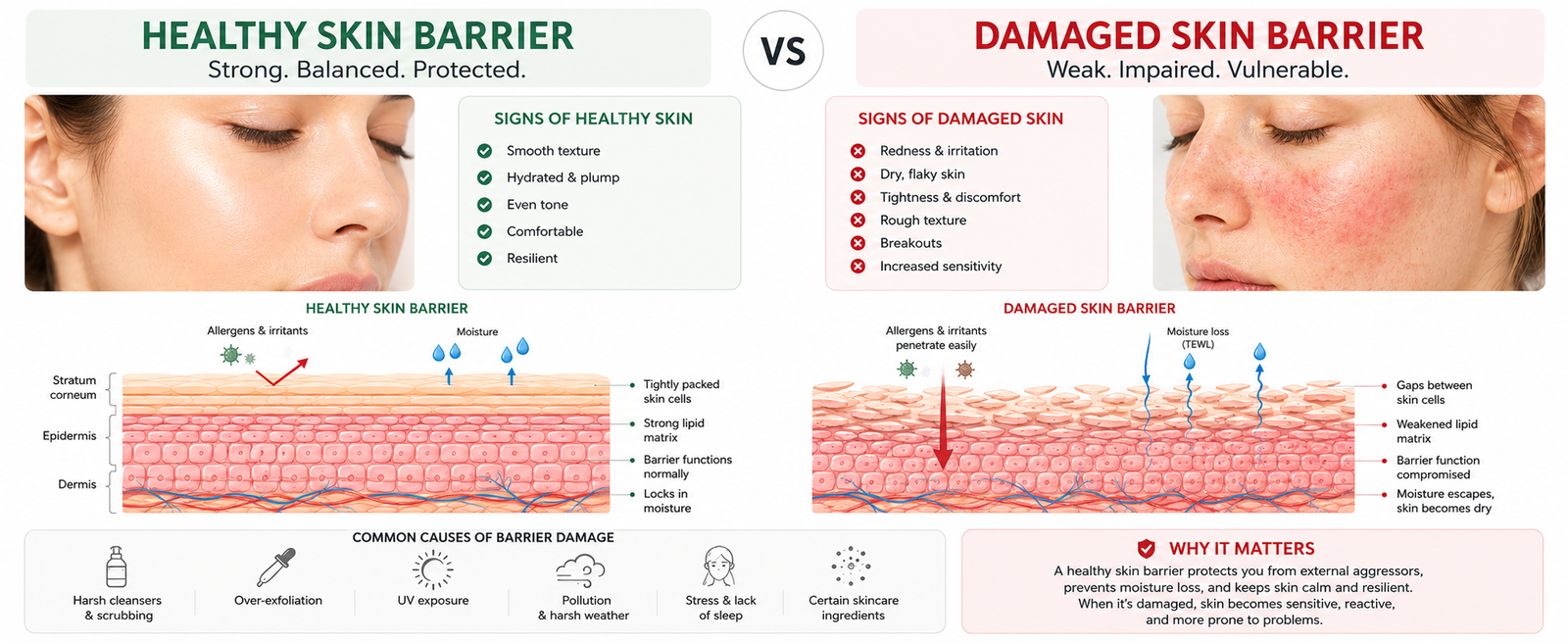
- Signs of a Damaged Skin Barrier
- What Causes Skin Barrier Damage?
- Can a Damaged Skin Barrier Heal Itself?
- How Long Does Skin Barrier Repair Take?
- How to Repair Your Skin Barrier: Step-by-Step
- Best Ingredients for Skin Barrier Repair
- Skin Barrier Repair for Sensitive Skin
- Myth vs Fact
- When to See a Dermatologist
- FAQs
- Key Takeaways
What Is the Skin Barrier?
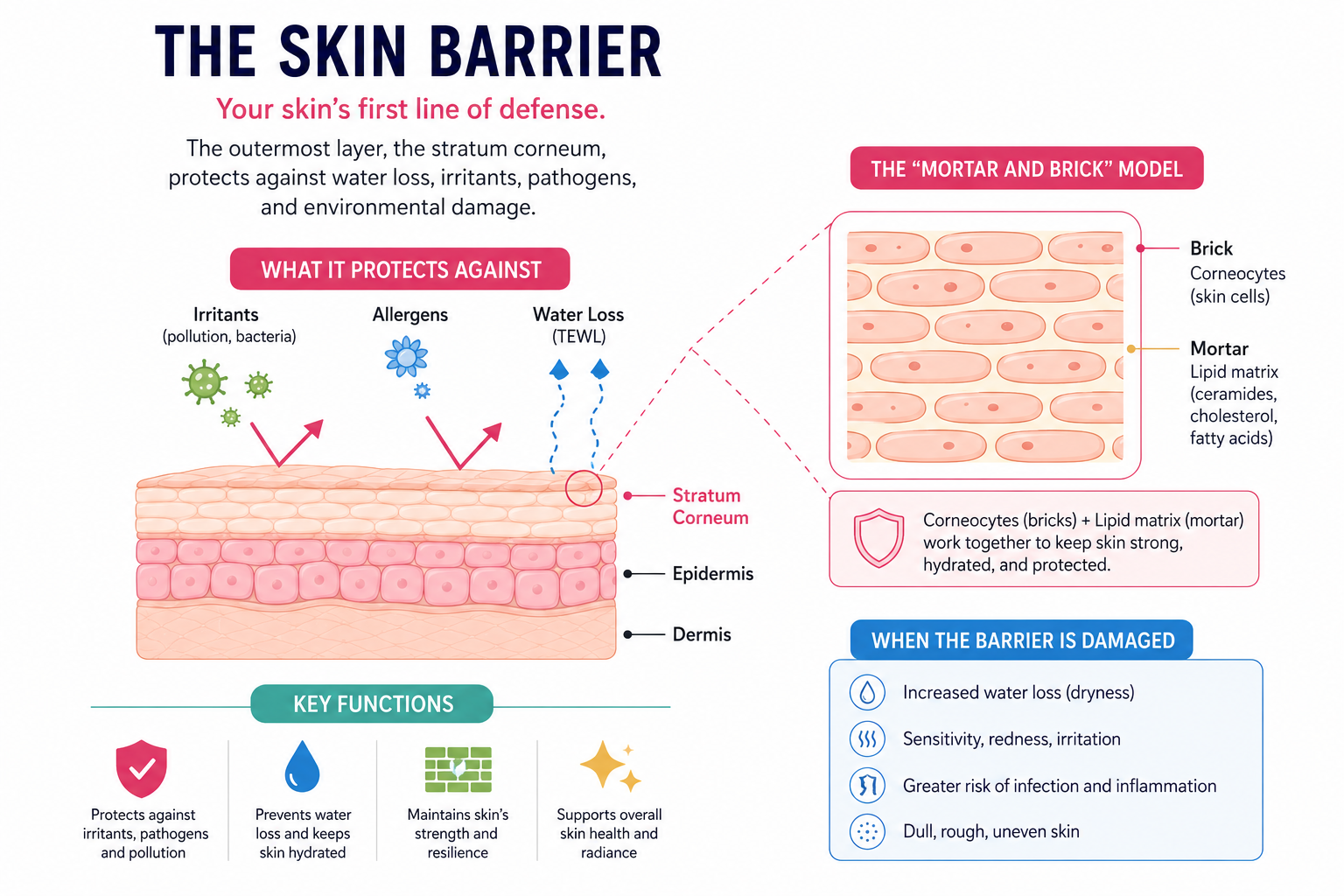
The stratum corneum, the outermost layer of skin, forms the body’s main physical barrier
The “skin barrier” usually refers to the outermost layer of the epidermis, called the stratum corneum. Dermatological research describes it using a “bricks and mortar” model: flattened, dead skin cells called corneocytes act as the bricks, while a matrix of lipids, mainly ceramides, cholesterol, and free fatty acids, forms the mortar that holds everything together.
This structure isn’t passive. During the final stages of skin cell development, keratinocytes produce a protein called filaggrin, which helps bundle keratin fibres and gives corneocytes their flattened shape. Filaggrin later breaks down into what’s known as natural moisturising factor (NMF), a group of substances that help the skin’s surface hold onto water and maintain its slightly acidic pH.
Beneath the stratum corneum, the deeper living layers of the epidermis contribute too. Structures called tight junctions, along with desmosomes and gap junctions, help control what passes between skin cells and support barrier recovery when the surface is compromised.
In short, a healthy skin barrier depends on three things working together:
- Lipids – fats that fill the spaces between skin cells and prevent water escaping
- Natural moisturising factors (NMF) – water-attracting compounds derived from filaggrin
- Corneocytes and cell junctions – the structural cells and connections that hold the barrier together
What Does the Skin Barrier Actually Do?
The skin barrier performs two jobs simultaneously, often described as the “inside-outside” and “outside-inside” barriers.
- Inside-outside barrier: Controls transepidermal water loss (TEWL), the process by which water evaporates from inside the body through the skin. A well-functioning barrier keeps TEWL low, keeping skin hydrated.
- Outside-inside barrier: Prevents harmful substances, allergens, irritants, and microbes from penetrating the skin and triggering a reaction.
The skin’s slightly acidic surface pH, typically between 4.5 and 5.5, supports both functions. This acidity helps enzymes responsible for producing ceramides work properly, restricts bacteria that thrive in more neutral conditions, and supports a healthy skin microbiome.
When either side of this barrier is compromised, TEWL rises, and the skin becomes more vulnerable to irritants, which is where visible symptoms begin to appear.
Signs of a Damaged Skin Barrier
A compromised skin barrier tends to present with a recognisable cluster of symptoms. These aren’t always dramatic; sometimes it’s a gradual sense that your skin “isn’t behaving” the way it used to.
| Sign | What’s Happening Underneath |
| Dryness and tightness | Reduced lipid content means the skin can’t hold onto moisture, increasing TEWL |
| Redness and irritation | Weakened defences allow irritants and allergens to penetrate more easily |
| Flaking or rough texture | Disrupted shedding of dead skin cells (desquamation) leads to visible buildup |
| Stinging or burning with products | Loss of protective lipids exposes nerve endings to previously tolerated ingredients |
| Increased product sensitivity | The barrier can no longer buffer against active ingredients as effectively |
| Dull, uneven tone | Reduced hydration and slower cell turnover flatten the skin’s appearance |
| More visible fine lines | Dehydrated skin appears less plump, making existing lines more noticeable |
What Causes Skin Barrier Damage?
Skin barrier damage is rarely caused by one single factor. It’s usually a combination of habits, products, and environment that overwhelm the skin’s capacity to repair itself.
| Cause | How It Damages the Barrier |
| Over-exfoliation | Repeated use of acids or scrubs strips lipids faster than skin can replace them |
| Harsh cleansers | High-pH or sulphate-heavy cleansers disrupt the acid mantle and lipid matrix |
| Retinoids and strong actives | Increase cell turnover, which can temporarily thin the stratum corneum |
| Environmental stress | UV exposure, pollution, and extreme temperature or humidity increase TEWL |
| Hot water and long showers | Strips natural oils and disrupts lipid organisation |
| Underlying skin conditions | Atopic dermatitis and psoriasis are strongly linked to genetic and functional barrier defects |
| Nutrient deficiencies | Vitamins A, B3, B7, and D all play roles in keratinocyte function and lipid or filaggrin synthesis |
Research also shows that after an increase in cytokines such as TNF, IL-1, and IL-6 following barrier disruption, the skin naturally attempts to repair lipid production. But when disruption is repeated or chronic, this cytokine response can tip into ongoing inflammation rather than resolution. This helps explain why skin that’s damaged repeatedly, through over-exfoliation, for example, becomes progressively more reactive rather than adapting.
That said, self-repair has limits. If the underlying cause (harsh actives, over-cleansing, an untreated skin condition) continues, the barrier doesn’t get the chance to complete its repair cycle, and symptoms can become chronic.
How Long Does Skin Barrier Repair Take?
There’s no single universal timeline; recovery depends on the extent of damage, your skin type, and how consistently you support the repair process. As a general guide:
- Mild disruption (occasional dryness, brief over-exfoliation): often improves within a few days to two weeks with basic care
- Moderate damage (persistent redness, stinging, flaking): commonly takes four to six weeks of a simplified routine
- More significant or chronic barrier dysfunction: can take several months, particularly if an underlying condition such as eczema is involved
Because the skin’s own repair processes, lipid synthesis, calcium gradient restoration, and epidermal cell turnover, take time to complete, patience and consistency matter more than intensity.
How to Repair Your Skin Barrier: Step-by-Step
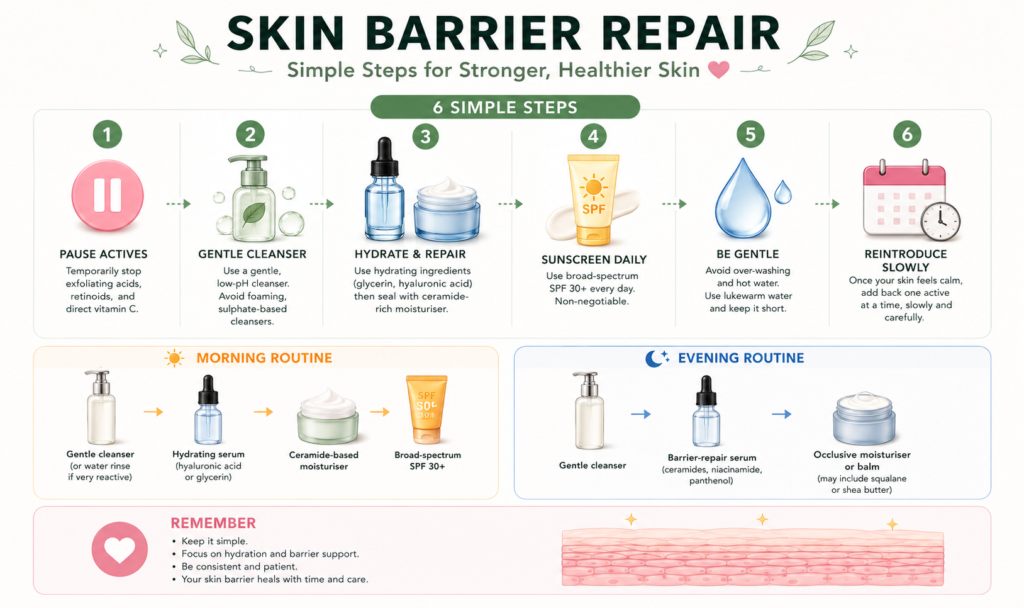
- Pause actives. Temporarily stop exfoliating acids, retinoids, and direct vitamin C. These can be reintroduced gradually once symptoms improve.
- Switch to a gentle, low-pH cleanser. Avoid foaming sulphate-based cleansers, which disrupt the acid mantle. Cream or gel cleansers are typically less stripping.
- Layer hydrating, barrier-supportive products. Look for humectants such as glycerin and hyaluronic acid to draw in water, followed by ceramide-rich moisturisers to seal it in.
- Use a broad-spectrum sunscreen daily. UV exposure is a recognised contributor to barrier disruption, so daily SPF is non-negotiable during repair.
- Avoid over-washing and hot water. Lukewarm water and shorter cleansing routines help preserve surface lipids.
- Reintroduce actives slowly. Once tightness, redness, and sensitivity have settled, bring back one active ingredient at a time, at a lower frequency, and watch how skin responds.
Suggested Morning Routine
- Gentle, low-pH cleanser (or water rinse only if skin is very reactive)
- Hydrating serum (hyaluronic acid or glycerin)
- Ceramide-based moisturiser
- Broad-spectrum SPF 30+
Suggested Evening Routine
- Gentle cleanser
- Barrier-repair serum (ceramides, niacinamide, panthenol)
- Occlusive moisturiser or balm (may include squalane or shea butter)
Best Ingredients for Skin Barrier Repair
| Ingredient | Role in Repair |
| Ceramides | Replenish the lipid matrix directly; a major structural component of the natural barrier |
| Cholesterol & fatty acids | Work alongside ceramides as core stratum corneum lipids |
| Niacinamide | Supports ceramide synthesis and has a calming effect on irritated skin |
| Glycerin | Humectant that draws water into the stratum corneum |
| Hyaluronic acid | Humectant that supports surface hydration at multiple skin depths |
| Panthenol | Soothes irritation and supports the skin’s water-holding capacity |
| Squalane | Lightweight emollient that helps prevent water loss without feeling greasy |
| Petrolatum | Highly effective occlusive; forms a protective film that reduces TEWL |
| Shea butter | Emollient and occlusive with fatty acid content similar to skin lipids |
| Colloidal oatmeal | Soothes itching and irritation; often used in sensitive-skin formulations |
| Urea | Humectant at low concentrations; supports NMF-like hydration |
| Ectoin | Helps stabilise cell membranes and protect against environmental stress |
| Allantoin | Soothing and mildly keratolytic, used to calm irritated, flaking skin |
| Centella asiatica | Traditionally used to calm redness and support skin healing |
| Beta glucan | Soothing polysaccharide that supports hydration and skin comfort |
Ingredients to pause during active repair: exfoliating acids (AHAs/BHAs), retinoids, direct vitamin C (L-ascorbic acid), physical scrubs, and alcohol-based toners.
Skin Barrier Repair for Sensitive Skin
Sensitive skin often has a naturally thinner or more reactive barrier, so the same principles apply but with extra caution:
- Patch test new products, even those labelled “gentle” or “fragrance-free”
- Introduce one new product at a time so you can identify triggers
- Favour fragrance-free formulations, as fragrance is a common irritant
- Keep routines minimal: cleanser, moisturiser, SPF, until stability returns
Myth vs Fact
Myth: You need to exfoliate to “help” a damaged barrier heal faster.
Fact: Exfoliation, whether physical or chemical, typically worsens barrier damage by removing more of the already-depleted lipid matrix. Repair periods call for less intervention, not more.
Myth: A damaged skin barrier means you need medical-grade actives.
Fact: The evidence points the other way. Simple, barrier-supportive formulations, ceramides, humectants, and occlusives, are generally more effective during active repair than potent actives.
Myth: Skin barrier damage is purely a skincare problem.
Fact: Genetics, nutrition, environment, and underlying skin conditions such as atopic dermatitis all influence barrier function, not just product choice (Proksch et al., 2008).
Myth: Moisturiser alone repairs the barrier.
Fact: Moisturisers help by reducing TEWL and improving hydration, but true barrier repair also involves lipid replenishment, avoiding further irritants, and giving skin time to regenerate its own structures.
When to See a Dermatologist
Most mild to moderate barrier disruption improves with a simplified routine. Speak to a dermatologist or GP if you notice:
- Symptoms persisting beyond six to eight weeks despite a gentle routine
- Signs of infection, such as oozing, warmth, or spreading redness
- Suspected underlying conditions like eczema, psoriasis, or contact dermatitis
- Severe or worsening pain, swelling, or widespread skin breakdown
FAQs
What is the skin barrier?
The skin barrier generally refers to the stratum corneum, the outermost layer of the epidermis, made up of corneocytes and a lipid matrix that regulates hydration and blocks harmful substances.
What does the skin barrier do?
It performs two functions: preventing water loss from inside the body (the inside-outside barrier) and blocking irritants, allergens, and microbes from entering (the outside-inside barrier).
How do you repair your skin barrier?
By pausing harsh actives, using a gentle cleanser, applying hydrating and lipid-replenishing products such as ceramides and humectants, and protecting skin with daily SPF.
How long does it take to repair the skin barrier?
Mild damage may improve within days to two weeks, while more significant disruption can take four to six weeks or longer, especially with chronic or underlying conditions.
Can the skin barrier heal itself?
Yes, the skin has natural repair mechanisms, including lipid resynthesis triggered by calcium changes in the outer skin layers. Removing the cause of damage supports this process.
What are the symptoms of a damaged skin barrier?
Common signs include dryness, tightness, redness, flaking, stinging with products, increased sensitivity, dullness, and more visible fine lines.
What ingredients repair the skin barrier?
Ceramides, cholesterol, fatty acids, niacinamide, glycerin, hyaluronic acid, panthenol, squalane, and occlusives like petrolatum or shea butter all support repair.
Can over-exfoliation damage the skin barrier?
Yes. Repeated exfoliation, physical or chemical, can strip lipids faster than the skin can replace them, disrupting the barrier.
Does retinol damage the skin barrier?
Retinoids increase cell turnover and can cause temporary barrier thinning and sensitivity, particularly when introduced too quickly. Gradual use and moisturising can offset this.
Is vitamin C safe for a damaged skin barrier?
Direct forms like L-ascorbic acid can be irritating on compromised skin. Gentler, water-soluble derivatives are usually better tolerated during repair.
Should I stop exfoliating if my skin barrier is damaged?
Generally, yes, temporarily. Pausing exfoliation allows the lipid matrix to rebuild before reintroducing actives gradually.
How often should I moisturise a damaged skin barrier?
Twice daily is typical, morning and evening, though very dry or reactive skin may benefit from additional applications as needed.
Key Takeaways
- The skin barrier is mainly the stratum corneum: a “bricks and mortar” structure of corneocytes and lipids
- It performs two roles, retaining water and blocking harmful substances
- Common signs of damage include dryness, redness, flaking, and product sensitivity
- Over-exfoliation, harsh cleansers, and environmental stress are leading causes
- The skin has natural repair mechanisms, but chronic irritation can prevent full recovery
- A simplified routine with ceramides, humectants, and occlusives supports skin barrier repair
- Recovery timelines vary from days to several months depending on severity
Conclusion
Skin barrier repair isn’t about adding more products; it’s usually about removing what’s causing harm and giving the skin’s own repair systems room to work. Understanding the biology behind the stratum corneum, its lipids, and its natural moisturising factors makes it easier to see why gentle, consistent care outperforms aggressive intervention. With patience, the right ingredients, and attention to any underlying triggers, most people can restore a healthy, resilient skin barrier over time.