
Interest in skin barrier health has grown fast, and gentle, protective ingredients now sit alongside the more active ones. Ectoin is one of them, a molecule made by microorganisms that survive extreme salt, heat, drought and radiation. Ectoin for skin has become a talking point because it appears to help cells hold on to a stable water environment.
The research is interesting, but it is smaller and more mixed than the marketing often suggests. This article covers what ectoin is, how it may work, what human studies have measured, and which claims still need stronger evidence.
What Is Ectoin?
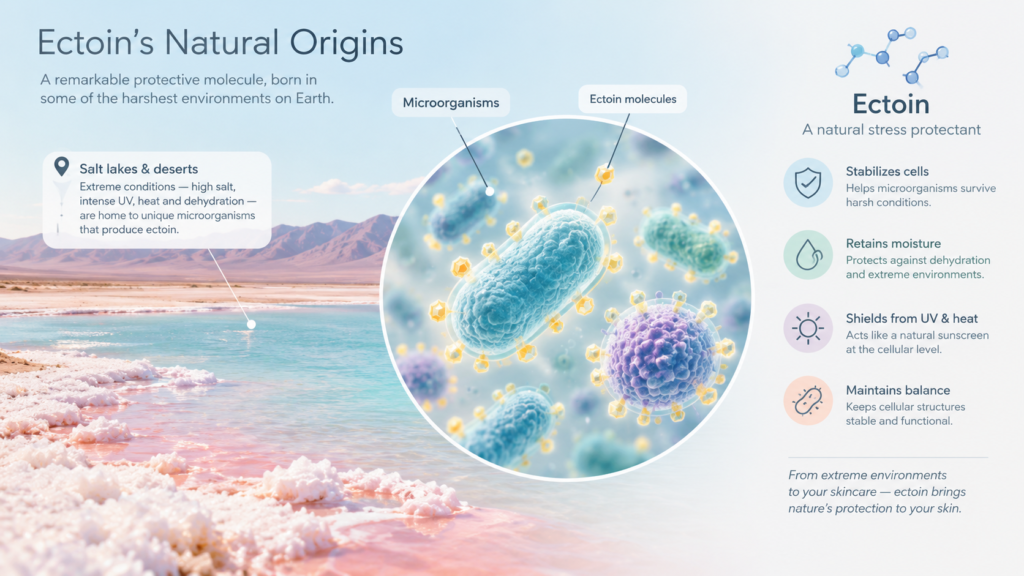
Ectoin is a small, naturally occurring amino acid derivative. It was first described in 1985 by Galinski in a salt-loving bacterium, Ectothiorhodospira halochloris (Wang et al., 2025). It is made by microorganisms living in salt lakes, deserts and geysers, where drying and radiation are constant threats.
Scientists call molecules like this extremolytes, and ectoin is also a compatible solute. Think of a microorganism packing a protective layer for a hostile journey. Ectoin builds up inside the cell and helps keep water balanced without interfering with the cell’s normal machinery. It does this in bacteria, and researchers wondered whether it might offer similar support to human skin cells.
Ectoin is not an exfoliating acid, a retinoid or a collagen-signalling peptide. Its interest lies in protection and hydration, not in speeding up cell turnover.
How Does Ectoin Work on the Skin?
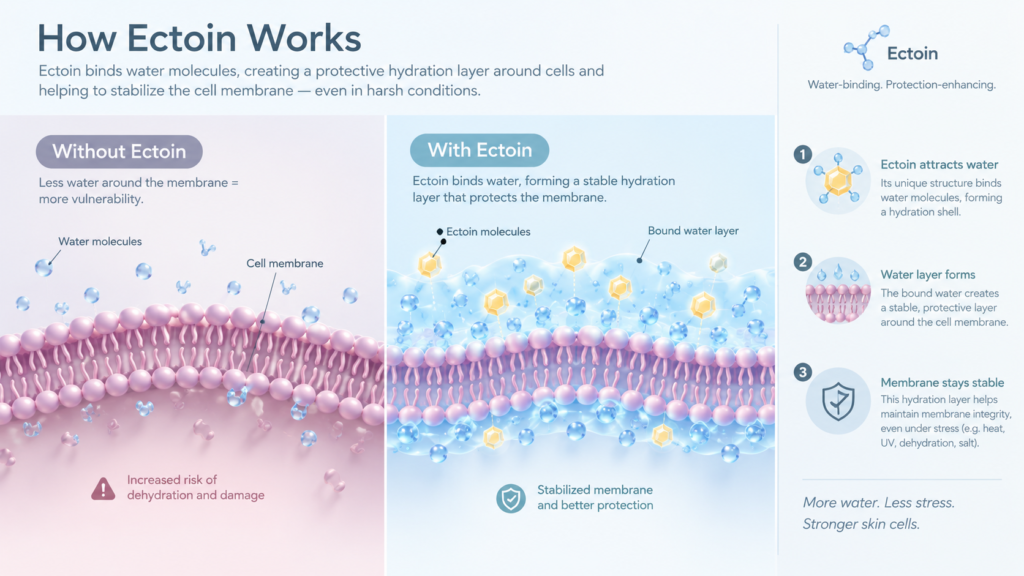
The leading explanation is called preferential hydration. Ectoin is thought to bind water and organise a “water shell” around proteins and cell membranes. Wang et al. (2025) describe ectoin binding water through strong hydrogen bonds. A stable water layer may make these structures less vulnerable to drying, heat or chemical stress (Upper airways systematic review, PMC6732621).
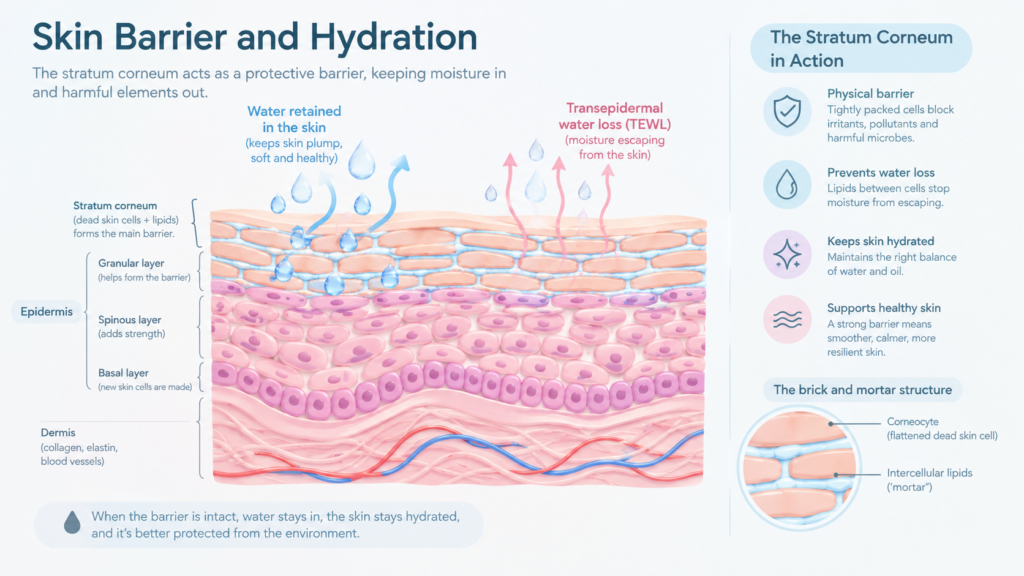
For skin, the relevant layer is the stratum corneum, the outermost barrier. It works like a brick wall: flattened cells (the bricks) held together by lipids and protein junctions (the mortar). When the barrier is impaired, water escapes more easily, a process measured as transepidermal water loss (TEWL).
A proposed mechanism is not the same as a proven clinical outcome. Water-binding in a laboratory model suggests why ectoin might help. Only studies in people can show whether skin actually becomes more hydrated or less irritated. It also does not follow that ectoin repairs every kind of damage or reaches deep skin layers. The supplied research does not show that.
Potential Benefits of Ectoin for Skin
Skin Hydration and Moisture Retention
Ectoin’s water-binding behaviour makes hydration the most natural area to study. In ex vivo experiments on donated skin, ectoin appeared to spread out (disperse) clumped keratin, the main structural protein in skin cells. Treated tissue also thinned less after drying (roughly 2% versus 6%), which suggests better water retention under ordinary humidity (Keratin dispersion study, PMC8455723).
Human data are more limited. In a small study of skin damaged by a CO₂ laser, a 5% ectoin emulsion applied twice daily raised measured hydration from 54.4 to 72.5 units over a month. Skin treated with the base cream alone showed no significant change (CO₂ laser study, PMC12158106).
Hydration readings are not evidence of lasting structural change. A higher reading tells you the surface holds more water, not that skin has been rejuvenated.
Skin Barrier Support
The barrier depends on its lipids, protein junctions and water content. Ectoin does not replace any of these. The proposed role is to help maintain a favourable hydration environment while the barrier recovers.
In the laser study, untreated laser-damaged skin lost more water over the month, with TEWL rising from 6.1 to 7.7 g/(m²·h). With the 5% ectoin emulsion twice daily, TEWL fell from 6.2 to 5.3 (CO₂ laser study, PMC12158106). The keratin study also found effects on how tightly skin cells cohere, but only in laboratory tissue, and the authors noted that increased cohesion is not necessarily desirable (PMC8455723).
Both studies concern ectoin within a formulation, and one involves a very specific kind of skin injury. Neither shows what an everyday serum does for healthy skin.
Ectoin for Sensitive and Irritated Skin
Sensitive skin often has a weaker barrier, so irritants and allergens get in more easily. This is where the human evidence is strongest. A systematic review identified six clinical studies, five in atopic dermatitis and one in retinoid dermatitis, with 525 recruited participants and ectoin concentrations of 5.5–7% (Systematic review, PMC8850511).
Some key points from that review:
- Marini et al.: In 65 adults, a randomised, double-blind, intraindividual trial found a 7% ectoin cream non-inferior to a reference cream (Atopiclair) for mild-to-moderate atopic dermatitis. This is the best-designed study in the set.
- Hon et al.: In 30 children, TEWL improved but measured skin hydration did not, and the authors linked this to dry seasonal conditions.
- Retinoid dermatitis: In people on isotretinoin, a 7% ectoin cream was compared with dexpanthenol cream, and both groups improved. The study was not blinded.
- The limitations matter. Most studies lasted about four weeks, several were open-label, and many participants were also using corticosteroids or antihistamines. Study certainty was rated from very low to moderate. This is not evidence that ectoin cures eczema or any other condition. It suggests ectoin-containing creams may be a useful supportive moisturiser in impaired-barrier skin, alongside medical care.
Environmental and Photodamage Protection
Ultraviolet (UV) light generates reactive molecules that damage DNA, break down collagen and trigger inflammation. So researchers are interested in anything that might buffer this stress.
The evidence here is laboratory-based. Wang et al. (2025) tested “D-Ectoin”, a cofermentation product of ectoin and a heat-loving bacterium, Thermus thermophilus. In skin fibroblasts and a 3D skin model, it reduced inflammatory signals, lowered a marker of oxidative DNA damage after UVB, and reduced a collagen-degrading enzyme (MMP-1). Its ability to increase a protective protein (Nrf2) was only modest.
This is not evidence about ectoin alone, because D-Ectoin contains other bacterial components. In two of the antioxidant tests, D-Ectoin performed no differently from ectoin alone, and in two others it performed better. None of this was tested on people, and ectoin is not a replacement for sunscreen or a proven SPF.
Ectoin and Skin Ageing
Interest in ectoin for anti-ageing rests mainly on hydration and surface feel. Wang et al. (2025) cite a randomised, vehicle-controlled trial of formulations with 2% ectoin reporting better hydration, elasticity and skin surface structure than the vehicle. We have not reviewed that trial directly, so treat this as a pointer, not a conclusion.
The cell studies suggest effects on collagen and MMP-1, but these do not translate directly to visible wrinkle change. Ectoin is not a proven wrinkle treatment, and nothing supports the idea that it reverses ageing.
Ectoin in Skincare Products
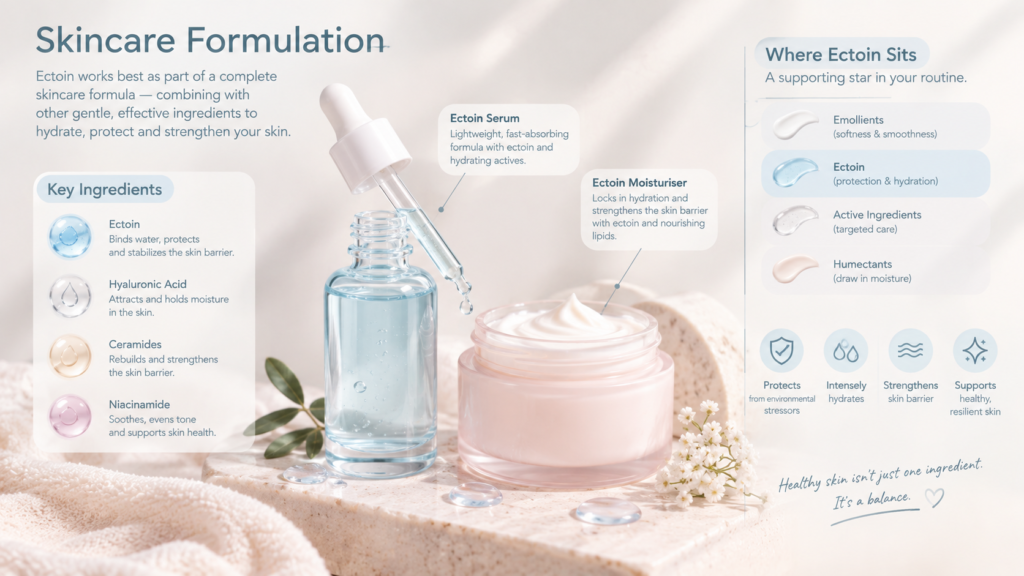
Ectoin appears in serums, moisturisers, creams and barrier-focused formulas, especially those aimed at dry or sensitive skin. It is water-soluble and is usually a supporting ingredient rather than the only active.
What matters is the whole product: the concentration, the base, the other ingredients and the quality of manufacture. The clinical creams in the review contained ceramide 3, glycerine, squalane and other moisturising components, so their results cannot be credited to ectoin alone. A study of one ectoin cream does not automatically apply to every ectoin serum or moisturiser, and no ideal concentration for cosmetic use has been established.
Who Might Benefit From Ectoin Skincare?
Based on the evidence so far, ectoin may be of interest to people who:
- want extra hydration in a leave-on product
- are interested in supporting their skin barrier
- have dry or sensitive-feeling skin and want a gentle routine
- are recovering from irritation and want a soothing, supportive ingredient
Responses vary between individuals, and there are no guaranteed results. Ectoin is not a substitute for diagnosis or treatment of a skin condition.
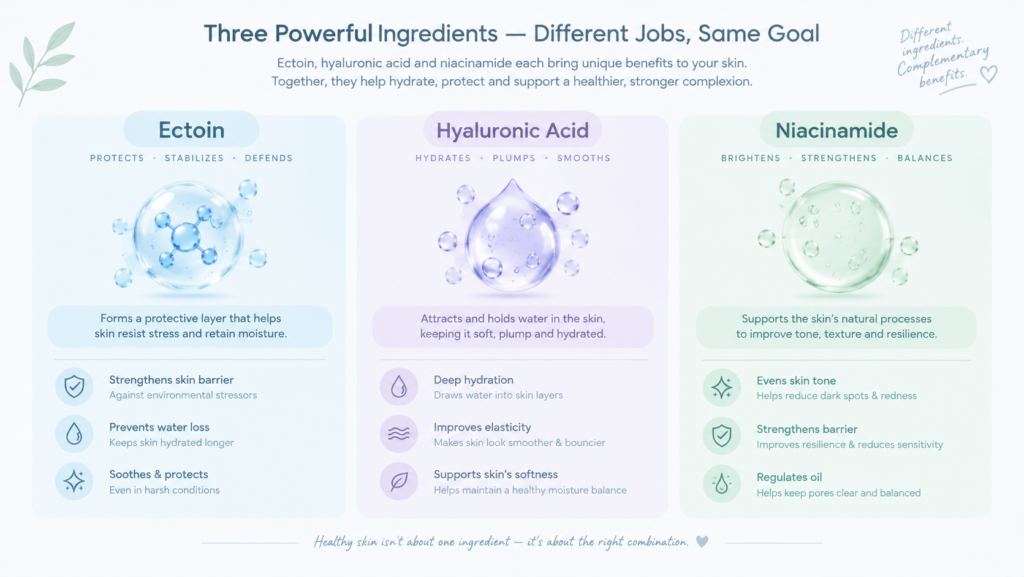
Ectoin vs Hyaluronic Acid vs Niacinamide
The supplied research does not compare these ingredients head to head. The table below gives general background on their usual roles. It is not a ranking, and the ingredients are not necessarily competitors.
| Feature | Ectoin | Hyaluronic Acid | Niacinamide |
| What it is | Amino acid derivative made by microorganisms | Sugar-based molecule that holds water | A form of vitamin B3 |
| Main skincare role | Hydration and protection | Surface hydration | Barrier and general skin conditioning |
| Key mechanism | Proposed preferential hydration around proteins and membranes | Binds water in the outer skin layers | Supports skin lipid and barrier processes |
| Hydration | Improved in some studies, mixed in others | Widely used for hydration | Indirect, via barrier support |
| Skin barrier support | Supported in small studies, mainly in formulations | Mainly through hydration | Commonly used for this purpose |
| Common product types | Serums, creams, sensitive-skin moisturisers | Serums, moisturisers | Serums, moisturisers |
| Evidence considerations | Small, short trials, mostly multi-ingredient products | Extensive use; results vary by formulation | Extensive use; results vary by formulation |
What Does Scientific Research Say About Ectoin?
It helps to separate three types of evidence.
Human clinical evidence: The systematic review of six studies (525 participants), the double-blind trial in 65 adults, and the laser study in 30 people. These show that ectoin-containing creams can improve dryness-related measures and symptom scores in some skin conditions, and that they are generally tolerated.
Laboratory or preclinical evidence: The keratin experiments on donor skin and the cell and skin-model work on D-Ectoin. These support how ectoin might act but do not show benefits in people.
Proposed mechanisms: Preferential hydration, membrane stabilisation and antioxidant effects. They are plausible and fit the data, but are not established clinical outcomes.
The main gaps are worth stating plainly:
- small numbers and short follow-up
- different concentrations, formulations and outcome measures
- concurrent treatments, which make it hard to isolate ectoin’s contribution
- little independent replication
- results that may not carry over from one product to another
The reviewers themselves called for larger, high-quality randomised trials. Research on ectoin in the upper airways (PMC6732621) is background only and says little about skin. The evidence is promising, not definitive.
How to Incorporate Ectoin Into a Skincare Routine
Ectoin is usually found in leave-on products, so follow the label directions. It can generally be layered with other compatible products, depending on the formulation. Combining it with hyaluronic acid or niacinamide is common, but the supplied research does not test these combinations, so check each product’s guidance.
If your skin is reactive, introduce a new product gradually. See a pharmacist, GP or dermatologist if you have persistent irritation or a diagnosed skin condition, particularly if you use prescription treatments.
Frequently Asked Questions
1. What does ectoin do for skin?
Ectoin is a water-binding, protective molecule. In small studies, ectoin-containing creams improved dryness-related measures and symptom scores in some impaired-barrier conditions. The benefits are supportive, not transformative.
2. Is ectoin good for sensitive skin?
It is generally well tolerated in the studies reviewed, and it was tested in atopic dermatitis and retinoid-related irritation. Some people did report mild stinging or burning. Sensitive skin varies, so introduce products gradually.
3. Does ectoin help repair the skin barrier?
Studies suggest it may support recovery by helping skin retain water, and TEWL improved in some trials. Those results came from specific creams, so they do not prove that every ectoin product repairs the barrier.
4. Can ectoin improve skin hydration?
Sometimes. Hydration rose in the laser study and in tissue experiments, but one trial in children found improved TEWL without a change in measured hydration. Results depend on the formulation and the skin.
5. Is ectoin safe for daily use?
Studies of up to six months found ectoin-containing formulations generally well tolerated. The evidence is limited, though, and safety depends on the full product. Stop using it and seek advice if irritation persists.
6. Can ectoin be used with retinol?
The supplied research does not test ectoin alongside topical retinol. One study used an ectoin cream during isotretinoin treatment, and it was tolerated. If you use retinoids, particularly prescribed ones, ask a pharmacist or dermatologist.
7. Is ectoin better than hyaluronic acid?
There is no evidence in our sources that either is superior. They work differently and can suit different needs. The choice depends on your skin and the specific product, not a universal winner.
8. Is ectoin scientifically proven to work?
There is credible research, including a double-blind trial, but the evidence base is small. Ectoin is a well-studied molecule with promising results, but “proven” overstates what the human data show.
Conclusion
Ectoin is a protective molecule made by microorganisms that thrive under stress, and researchers are studying ectoin for skin because of its water-binding and membrane-stabilising properties. Human studies suggest that creams containing it can support hydration and barrier-related measures, and that they are generally well tolerated, particularly in dry, sensitive or impaired-barrier skin.
The limits matter as much as the promise. Trials have been small and short, most tested multi-ingredient products, and laboratory findings on photodamage and ageing have not been confirmed in people. Ectoin is a scientifically interesting skincare ingredient with promising research, and claims about it should stay in proportion to that evidence.