
Regenerative skincare has moved on from surface-level actives like retinol and vitamin C. The newest frontier in aesthetic dermatology is cell-to-cell communication, and at the centre of it are exosomes. Exosomes for skin have become one of the most searched, most marketed and most misunderstood topics in modern skincare, appearing in serums, facials and injectable clinic treatments alike.
Exosomes are tiny particles released by cells that are thought to help coordinate repair, regeneration and communication between skin cells. Researchers are investigating whether they could support skin rejuvenation, wound healing and even hair regrowth, and a wave of reviews published in 2025 and 2026 has tried to make sense of the growing body of evidence [1][2][7]. The interest is genuine and the underlying biology is fascinating. But as with many emerging skincare ingredients, enthusiasm has outpaced proof. This article sets out, clearly and without hype, what exosomes are, what the science currently shows, and what still needs to be established before exosomes for skin can be considered a proven treatment.
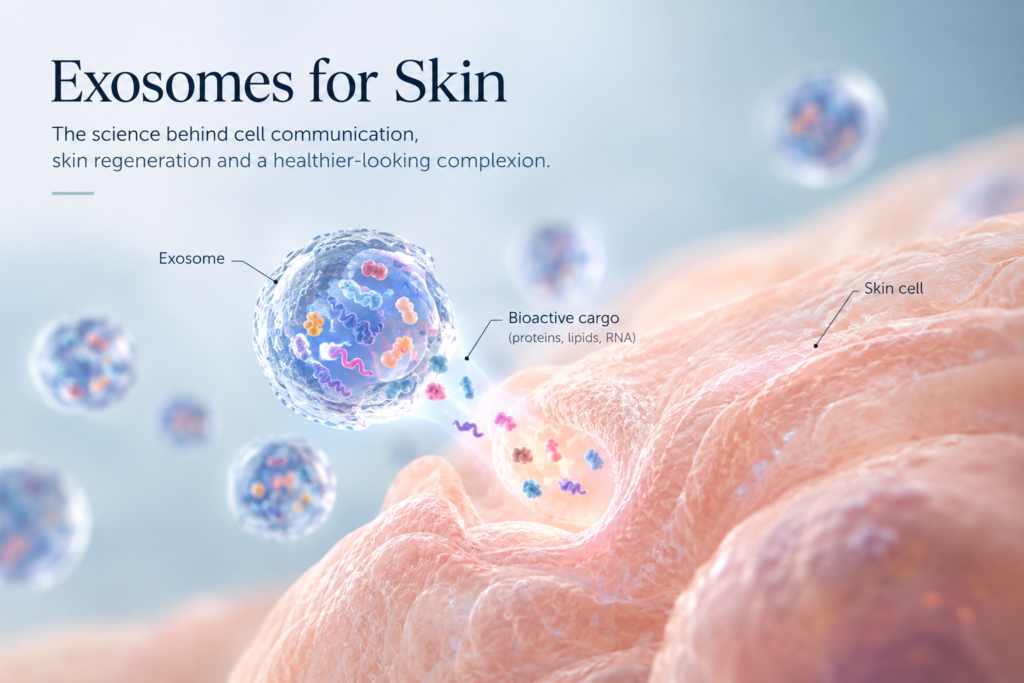
What Are Exosomes?
Exosomes are extracellular vesicles — tiny, membrane-bound packages released by almost every cell in the body, including skin cells such as keratinocytes, fibroblasts and melanocytes. They typically measure somewhere between 30 and 160 nanometres across, thousands of times smaller than a human cell.
A useful way to picture them is as tiny biological “messenger packages”. When a cell wants to communicate with a neighbouring cell, or influence how that cell behaves, it can package up a set of instructions inside an exosome and release it. The receiving cell takes up the exosome and “reads” its contents, which can change how that cell functions.
Inside each exosome is a mixture of biological material from the parent cell, which may include:
- Proteins, including enzymes and structural proteins
- Lipids that make up the vesicle’s outer membrane
- RNA and microRNA, which can influence gene activity in the receiving cell
- Signalling molecules involved in inflammation, repair and cell growth
It’s important to be clear about one thing: exosomes are not stem cells. They don’t divide, they don’t turn into new tissue, and they contain no living cells at all. They are better understood as a delivery system — a way that cells (including stem cells) communicate with one another — rather than a regenerative cell therapy in their own right. This distinction matters because some marketing blurs exosomes and stem cell therapy together, when they are biologically quite different.
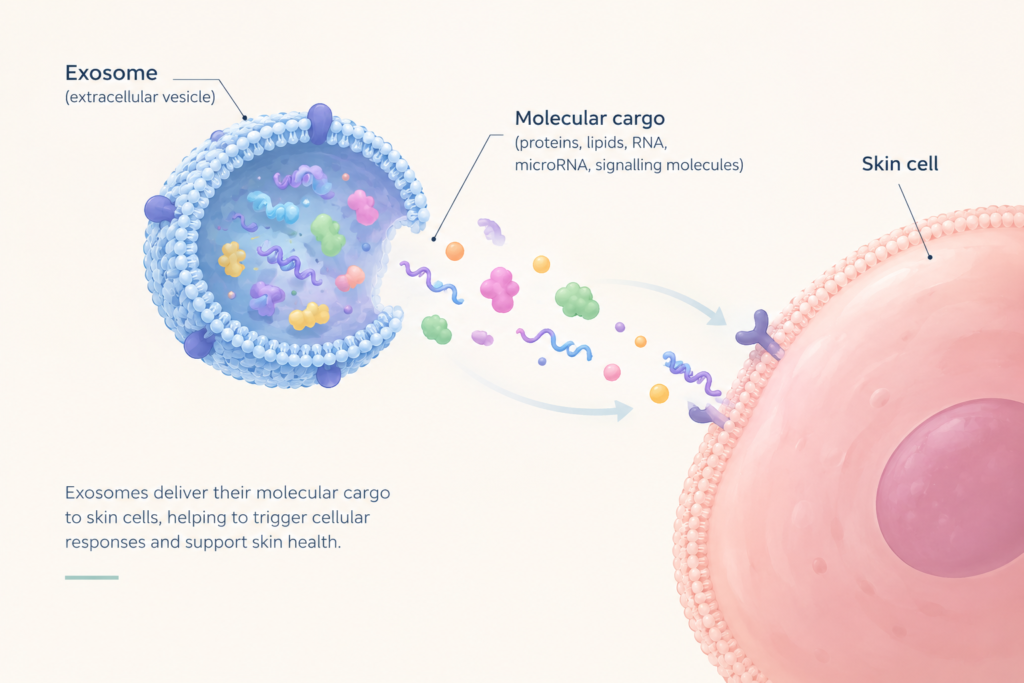
Tiny messengers, carrying signals that may shape how skin repairs, responds and renews
How Do Exosomes Work on Skin?
Most of what we know about how exosomes affect skin comes from laboratory studies using isolated skin cells, and animal studies using mice or rats — not from people. In these preclinical settings, researchers have observed that exosomes derived from sources such as mesenchymal stem cells, platelets, and even plants or bacteria can influence several processes relevant to skin health, including:
- Fibroblast activity, the cells responsible for producing collagen and elastin
- Collagen and elastin production, key structural proteins that keep skin firm
- Reduced oxidative stress caused by UV exposure
- Modulation of inflammation, including in inflammatory skin conditions
- Support for wound healing, including cell migration and new blood vessel formation
- Skin barrier–related processes, such as hydration and lipid production
This is genuinely interesting biology, and it’s one reason exosomes have attracted so much research attention. However, there’s a critical distinction to keep in mind throughout this article: what happens in a laboratory dish or in mice does not automatically happen the same way in living human skin. Human skin is thicker, structurally different, and exposed to a completely different environment than cultured cells or animal models.
Human clinical studies do exist, and a growing number were published in 2024 and 2025, but they are still relatively few, mostly small, and often not randomised or placebo-controlled. So while the proposed mechanisms are well described in preclinical research, the leap to “proven human benefit” is one the current evidence hasn’t fully made yet.
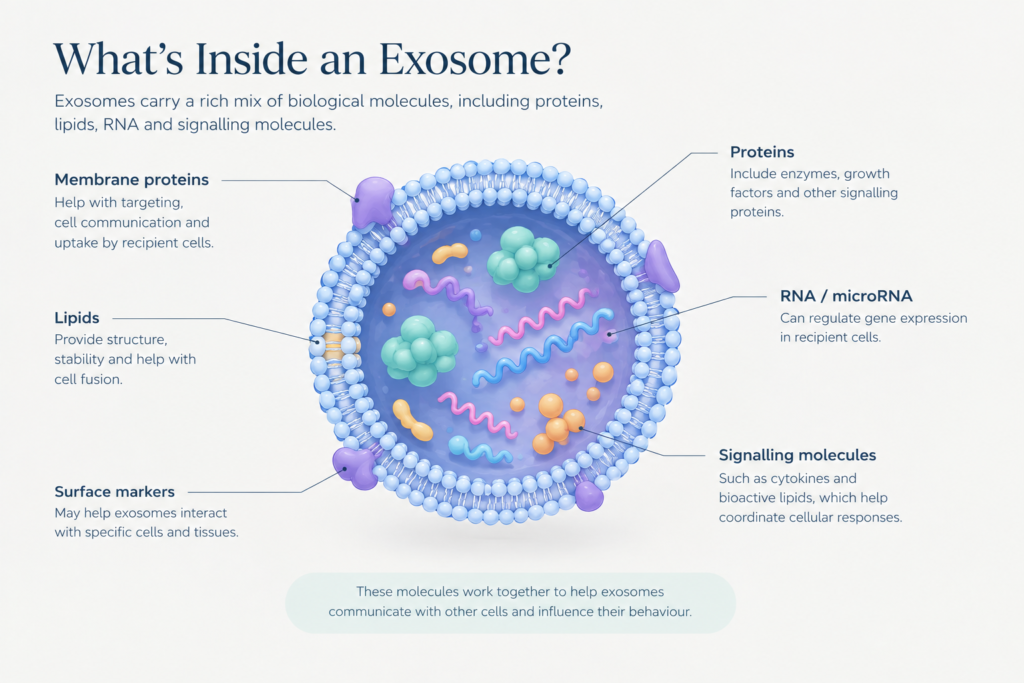
Exosomes are tiny biological packages, carrying proteins, lipids and RNA that help cells communicate and respond to their surroundings.
Potential Benefits of Exosomes for Skin
Below is what researchers are currently investigating, organised by skin concern. Where evidence is limited to laboratory or animal research, that is stated explicitly.
Skin Rejuvenation
Several small human studies have looked at topical or injected exosome preparations and reported improvements in overall skin appearance, including texture, tone and general “skin health” scores, typically measured over six to twelve weeks. These studies are promising, but most involve small groups of participants (often fewer than 60), are not randomised against a placebo, and follow people for a relatively short period.
Fine Lines and Wrinkles
The proposed link between exosomes and wrinkles rests on their reported ability to stimulate fibroblasts to produce more collagen and elastin, and to reduce the enzymes that break collagen down. Some split-face and single-arm human trials have reported measurable reductions in wrinkle depth using imaging devices, alongside increases in skin elasticity. Early studies indicate a possible benefit here, but sample sizes are small and results vary between exosome sources and products.
Skin Hydration and Barrier Function
A number of studies, including trials using platelet-derived and bacterial (Lactobacillus-derived) exosomes, have reported improvements in skin hydration after several weeks of topical use. The proposed mechanism involves support for the skin’s natural barrier lipids, though the exact pathway in human skin is still being investigated.
Acne Scars and Wound Healing
Exosomes have been studied for their potential to support wound healing at several stages of the repair process, including reducing excessive inflammation and encouraging more organised collagen deposition, which may reduce scarring in animal models. In humans, small case series and pilot studies combining exosomes with treatments like microneedling or fractional laser have reported improvements in acne scarring and faster recovery after procedures, but controlled comparative trials remain limited.
Hyperpigmentation
Laboratory research suggests that exosomes from certain sources may reduce melanin production by influencing the signalling pathways that control pigment-producing cells (melanocytes). A small number of human studies, including split-face designs, have reported reduced pigmentation and improved skin brightness after several weeks of use. As with other areas, evidence remains limited to small studies, and results have not been consistently reproduced across different exosome sources.
Photoaging
Photoaging — the skin damage caused by cumulative UV exposure — involves oxidative stress, collagen breakdown and inflammation. In laboratory and animal studies, various exosome types have been shown to reduce UV-induced oxidative damage and support collagen recovery. This is one of the more consistently reported preclinical findings, though it has been evaluated in humans mainly indirectly, through general skin rejuvenation trials rather than photoaging-specific research.
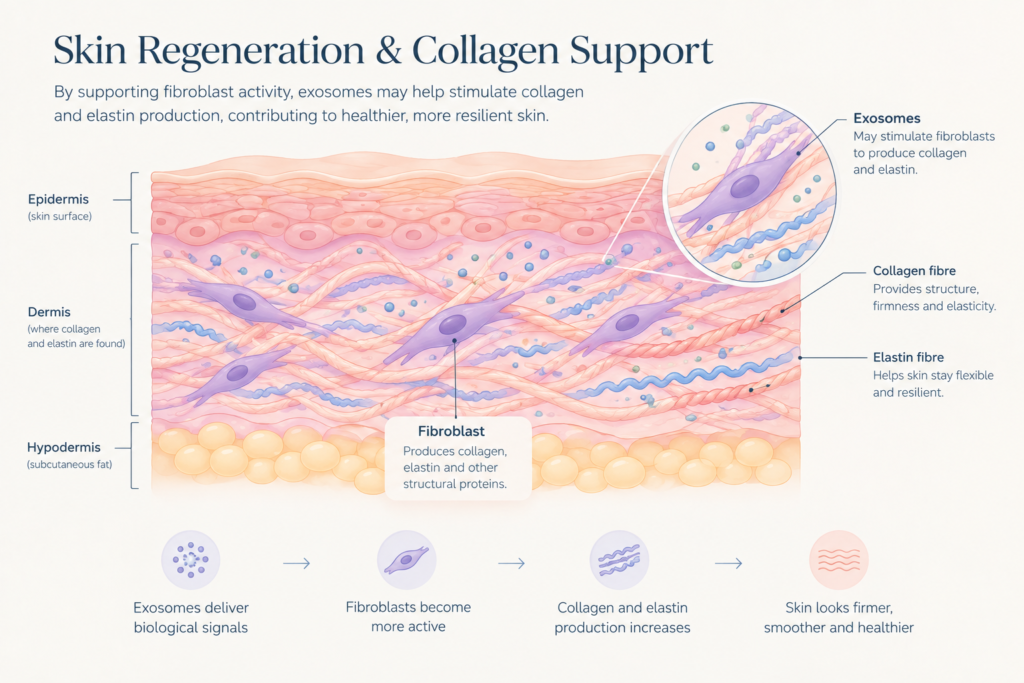
By influencing cellular signalling, exosomes may support the processes involved in collagen and skin repair.
Do Exosomes Really Work for Skin?
This is the question most people actually want answered, and the honest response is: it depends on what you mean by “work”.
There is a reasonably large body of laboratory and animal research showing that exosomes can influence processes relevant to skin health. There is a smaller, but growing, body of human research — several systematic reviews published in 2025 and 2026 have collectively identified fewer than 40 relevant human clinical studies across the entire field. Within that human evidence:
- Most studies are small, often involving fewer than 60 participants
- Many are single-arm (no control group) or short in duration — typically weeks rather than months or years
- Exosome source (human platelets, adipose stem cells, plant material, bacteria and others) varies enormously between studies, and different sources appear to behave differently
- Isolation and preparation methods are not standardised across manufacturers or researchers, which affects the purity, concentration and consistency of any given product
- Systematic reviews consistently flag a lack of large, randomised, placebo-controlled trials with long-term follow-up as the field’s central limitation
In short: the early results are genuinely encouraging for several skin concerns, particularly hydration, elasticity and general skin appearance, but “encouraging early data” is a different claim from “proven treatment”. No major regulatory body currently endorses exosomes as an established, standardised treatment for any cosmetic skin concern.
Are Exosomes Safe for Skin?
Reported safety data from clinical studies has generally been reassuring for topical use, with most adverse effects described as mild and temporary — things like redness, dryness or mild swelling after treatment. Serious reactions have been rare in regulated, well-conducted studies.
However, safety cannot be assessed as a single blanket statement, because it depends heavily on the individual product. Points worth understanding:
- Product quality and manufacturing standards vary considerably between suppliers, and there is currently no universal manufacturing standard specific to exosomes
- Poorly prepared exosome products can potentially carry unwanted biological material, including microbial contamination or unintended cellular components, which could trigger infection or an immune reaction
- The source of an exosome product (human, animal, plant or bacterial) affects both its likely activity and its risk profile, and this isn’t always transparently disclosed
- Long-term safety data, particularly for repeated or injectable use, is limited, simply because the research base is still young
- Documented cases of complications following unregulated injectable exosome treatments highlight the importance of product traceability and professional oversight
None of this means exosome skincare is inherently unsafe. It means that not all exosome products are equal, and knowing the source, manufacturer and regulatory status of a product matters more here than with most established skincare ingredients.

Exosome Skincare: Serums vs Professional Treatments
Topical Exosome Products
Exosome serums and creams are now widely available, but topical use raises a genuine formulation challenge: exosomes are relatively large, delicate particles, and the skin’s outer layer (the stratum corneum) is specifically designed to keep large molecules out. Whether meaningful quantities of intact, biologically active exosomes can actually penetrate into deeper skin layers from a standalone topical product is not yet well established and is likely to depend heavily on formulation, exosome source and concentration. This is one reason topical products are frequently paired with a delivery-assisting step such as microneedling.
Professional Aesthetic Treatments
In clinical settings, exosomes are sometimes applied topically immediately after microneedling or laser treatments, on the theory that creating temporary micro-channels in the skin may help exosomes reach deeper layers. Some clinics also offer injectable exosome treatments. These professional approaches are more closely studied than at-home products, but the research base is still made up largely of small, single-arm or short-term studies.
This article does not provide procedural guidance, dosing information or treatment protocols. If you’re considering a professional exosome treatment, this is a conversation to have with a suitably qualified, registered healthcare professional or dermatologist, who can advise on the specific product being used, its source, and its regulatory status.
An emerging approach to skin rejuvenation, with clinical evidence still developing.
Are Exosomes FDA Approved?
No exosome-based product has received FDA approval as a drug or biologic for any dermatological or cosmetic indication. In the United States, exosome products intended to treat, structurally alter or functionally affect the skin fall under FDA regulation as drugs or biologics, and would need to go through the same investigational approval pathway as other biologic therapies. Some exosome-containing skincare is instead marketed as a cosmetic, which carries a lower regulatory bar, provided the claims made are limited to appearance rather than therapeutic or structural effects. The US FDA has also previously issued public warnings about unapproved and unregulated exosome products being marketed for medical use.
It’s worth being specific here: this is a US regulatory description, not a global one. Regulatory frameworks differ significantly by country, and a product’s status in the US does not automatically tell you its status in the UK or EU. Regulatory approaches to extracellular vesicle–based products also differ between US, European and Asian regulators, generally treating them as advanced or biologic therapies when used for anything beyond cosmetic claims. For UK readers, this means checking a specific product’s regulatory status and manufacturer credentials directly, rather than assuming a claim of “FDA-tested” or “clinically studied” reflects full regulatory approval.
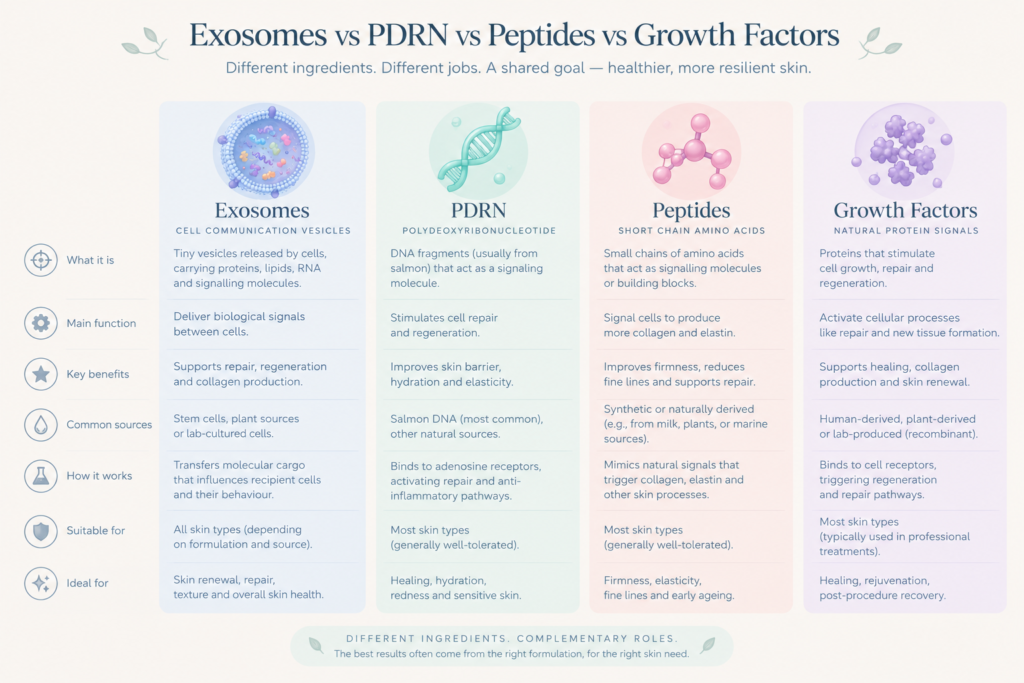
Exosomes vs PDRN vs Peptides vs Growth Factors
Exosomes are often mentioned alongside other “next-generation” skincare ingredients such as PDRN, peptides and growth factors. Here’s how they compare, in general terms:
| Ingredient/Approach | What It Is | Main Proposed Role | Evidence Status |
| Exosomes | Nanoscale vesicles released by cells, carrying proteins, lipids and RNA | Cell-to-cell signalling that may support repair, collagen activity and skin communication | Preclinical evidence is substantial; human evidence is growing but limited, small-scale and not standardised |
| PDRN | Polydeoxyribonucleotide, a DNA-derived molecule often sourced from salmon | Thought to support tissue repair and circulation via adenosine receptor activity | A longer track record than exosomes in some wound-healing and aesthetic contexts, though large-scale trials specific to cosmetic skin use are also limited |
| Peptides | Short chains of amino acids, the building blocks of proteins | Signal specific cellular processes, such as collagen synthesis, depending on peptide type | Some peptides have a reasonably established evidence base for specific effects; quality varies by peptide and formulation |
| Growth Factors | Naturally occurring proteins that regulate cell growth and repair | Directly stimulate specific cellular activity, such as fibroblast proliferation | Studied for longer than exosomes in dermatology; evidence varies by growth factor type and delivery method |
None of these approaches should be considered a “winner”. They work through different, sometimes overlapping mechanisms, and the right comparison depends on the specific product, its source, its formulation and the individual using it — questions best discussed with a dermatologist rather than settled by a single ingredient category.
What Does Current Research Actually Say?
Pulling the picture together: laboratory and animal research on exosomes and skin is extensive and mechanistically compelling, covering effects on collagen, inflammation, pigmentation and wound repair. Human clinical evidence is real but still emerging — recent systematic reviews from 2025 and 2026 have each identified fewer than 25 relevant human studies, most of them small, short-term and methodologically limited.
What looks promising:
- Short-term improvements in skin hydration, elasticity and overall appearance in several small trials
- A generally favourable short-term safety profile in regulated, well-conducted studies
- Plausible, well-documented biological mechanisms from laboratory research
What remains uncertain:
- Long-term efficacy and durability of results beyond a few months
- Whether topical products actually deliver active exosomes into the skin in meaningful amounts
- How different exosome sources and preparation methods compare to one another
- Standardised dosing, concentration and quality benchmarks across the industry
Standardisation is repeatedly flagged by researchers as the single biggest barrier to translating exosome science into reliable clinical practice. Until isolation methods, quality control and reporting are consistent across studies and manufacturers, comparing one exosome product’s claims to another’s — or to the research literature as a whole — remains genuinely difficult. This is the key distinction between scientific evidence and skincare marketing: the biology is credible, but the clinical proof is still being built.
Frequently Asked Questions
What are exosomes for skin?
Exosomes are tiny extracellular vesicles released by cells that carry proteins, lipids and RNA between cells. In skincare, they’re being investigated for their potential role in cell communication, repair signalling and supporting processes like collagen production, though they are not a treatment with fully established clinical proof yet.
Do exosomes really work for skin?
Some small human studies report improvements in hydration, elasticity and overall skin appearance after topical or professional exosome treatments. However, most studies are small and short-term, so “promising early evidence” is more accurate than “proven to work”.
Are exosome serums safe?
Reported side effects in clinical studies have generally been mild, such as temporary redness or dryness. Safety depends heavily on the specific product’s source and manufacturing quality, since standards vary considerably between suppliers.
Can exosomes reduce wrinkles?
Some studies report reduced wrinkle depth alongside increased elasticity, linked to proposed effects on collagen and elastin production. Results vary between exosome sources and studies, and larger, longer trials are needed before this can be considered established.
Can exosomes help acne scars?
Exosomes have been studied for supporting wound healing and more organised tissue repair, sometimes combined with microneedling or laser treatments for scarring. Early results are encouraging, but comparative human trials specific to acne scarring remain limited.
Are exosomes better than PDRN?
Not necessarily — they work through different mechanisms and haven’t been directly compared in robust head-to-head trials. Which is more suitable depends on the individual, the specific product and professional advice, rather than one being universally superior.
Are exosomes FDA approved?
No exosome product currently has FDA approval as a drug or biologic for skin treatment in the US. Some exosome-containing products are marketed as cosmetics, which face a lower regulatory bar, and regulations differ by country, including in the UK.
How long do exosomes take to work?
In the human studies available, reported improvements have typically been assessed over six to twelve weeks, though timelines vary depending on the product, delivery method and outcome being measured. Long-term data is still limited.
Are exosomes suitable for sensitive skin?
There isn’t strong dedicated research on exosome products specifically for sensitive skin. As with any active skincare ingredient, patch testing and professional advice are sensible, particularly given the current variability in product quality and sourcing.
Conclusion
Exosomes represent a genuinely interesting area of regenerative dermatology research, sitting at the intersection of cell biology and skincare innovation. The mechanisms researchers have identified — supporting collagen production, calming inflammation, and aiding wound repair — are backed by a substantial body of laboratory and animal evidence. Human clinical research is growing, and some early results for hydration, elasticity and overall skin appearance are encouraging.
But the evidence base remains young. Small sample sizes, short follow-up periods, inconsistent product standardisation and unclear regulatory status all mean that exosomes for skin should currently be understood as a promising research area rather than a proven, standardised treatment. Anyone considering an exosome-based product or clinic treatment should look for transparency about the product’s source, manufacturing standards and the qualifications of whoever is providing it, and treat bold before-and-after claims with appropriate caution.