
PDRN has moved from wound-care clinics into aesthetic dermatology over the past few years, showing up in injectable skin-booster treatments and, increasingly, in PDRN serums marketed for home use. The interest is understandable: PDRN for skin has decades of published research behind it, spanning diabetic ulcer trials, burn models, and more recent aesthetic studies on wrinkles, texture and pigmentation.
PDRN stands for polydeoxyribonucleotide, a DNA-derived biopolymer originally developed as a wound-healing drug and only later adopted by aesthetic medicine. It’s thought to work by calming inflammation, supporting new blood vessel growth, and feeding skin cells raw material they can reuse to repair themselves. It’s also frequently confused with a closely related compound called PN (polynucleotide), and the two terms are used inconsistently across the skincare industry.
This article explains what PDRN is, how it’s thought to work, what the evidence does and doesn’t support for skin, how PDRN compares with PN, and what’s currently known about its safety.
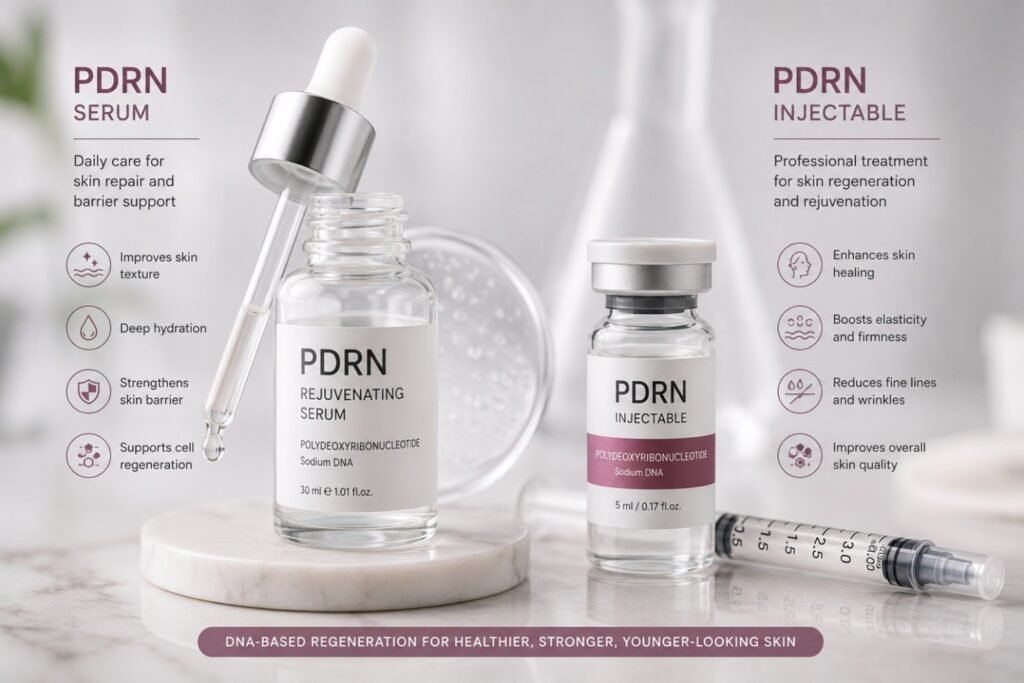
PDRN appears in both topical serums and professional injectable treatments, with very different levels of supporting evidence
What Is PDRN?
PDRN stands for polydeoxyribonucleotide. Strip away the scientific name and it’s essentially a fragment of DNA, extracted and purified rather than manufactured from scratch. In dermatology, that DNA is most commonly sourced from the sperm of specific fish species discussed in the research, chiefly rainbow trout (Oncorhynchus mykiss) and chum salmon (Oncorhynchus keta), because their DNA can be purified into a form compatible with human tissue and, when processed correctly, unlikely to trigger an immune response.
Structurally, PDRN is a chain of nucleotides, the individual building blocks of DNA, linked together into a double-stranded polymer. What matters clinically is the size of that chain, described by molecular weight (measured in kilodaltons, or kDa) and chain length. Research generally places PDRN somewhere in the range of roughly 50 to 1,500 kDa, though exact figures vary between manufacturers and studies. Compared with its larger relative, PN, PDRN is made of shorter chains, giving it a thinner, more fluid consistency rather than a thick, gel-like one.
This size difference isn’t just a technical detail. Chain length affects how a formulation behaves physically, how it’s broken down once inside tissue, and which biological pathways it can trigger. Shorter DNA fragments appear to interact directly with specific cell receptors in a way longer polynucleotide chains do not, at least not to the same extent, which is part of why PDRN attracted attention beyond its original use in wound care.
How Does PDRN Work on the Skin?
A2A adenosine receptor pathway
Cells carry various receptors on their surface that pick up chemical signals and translate them into an internal response. One family, adenosine receptors, responds to a molecule called adenosine and helps regulate inflammation, blood vessel formation, and tissue repair throughout the body. There are four known subtypes, and PDRN appears to selectively activate one: the A2A receptor.
When PDRN fragments bind to A2A receptors on skin cells, research indicates this switches on a chain of internal signals that tends to calm inflammatory activity, partly by damping down signalling pathways that otherwise drive inflammation. A2A activation has also been linked to increased production of vascular endothelial growth factor (VEGF), a signal that encourages the formation of new blood vessels, known as angiogenesis. Better local blood supply means healing tissue gets more oxygen and nutrients.
PDRN’s A2A activity has also been associated with increased activity in fibroblasts, the cells responsible for producing collagen and other structural proteins in the dermis, alongside a reduction in an enzyme called MMP-1 that otherwise breaks collagen down. Together, less inflammation, more blood supply, and more active fibroblasts form the proposed basis for PDRN’s role in tissue repair.
The nucleotide salvage pathway
The second mechanism is less about signalling and more about recycling. Building new DNA from scratch is energy-intensive for a cell. Think of the salvage pathway as a cellular recycling system: instead of manufacturing every nucleotide from raw materials, cells can pick up nucleotide fragments already available nearby and reuse them directly.
When PDRN breaks down in tissue, it releases nucleosides and nucleotides that nearby cells can absorb and recycle through this salvage pathway, rather than spending energy building them from nothing. This appears to matter most in damaged or oxygen-starved tissue, where the energy-hungry route for building new DNA is compromised. It’s worth being precise here: this isn’t PDRN ‘adding DNA’ to skin in any genetic sense. It’s supplying spare parts that a cell’s existing recycling machinery can use, supporting cell division and repair rather than altering genetic information.
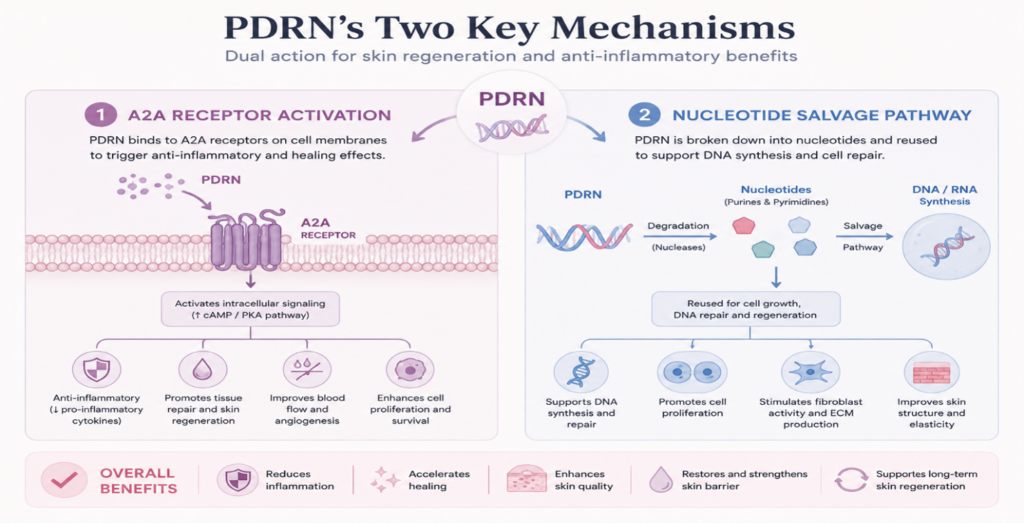
PDRN is thought to act on skin cells through two complementary pathways: receptor signalling and nucleotide recycling.
PDRN Skin Benefits: What Does the Evidence Suggest?
Skin regeneration and rejuvenation
Research in dermal fibroblasts suggests PDRN can increase metabolic activity and support production of structural skin proteins, largely through the mechanisms above. Reviews describe PDRN contributing to improved overall skin quality, though that’s a broad, subjective outcome, and most underlying evidence involves cell cultures and animal wound models rather than large trials measuring aesthetic rejuvenation specifically.
Collagen, elasticity and wrinkles
Laboratory studies report that PDRN can increase fibroblast production of collagen types I and III while reducing MMP-1, the enzyme that breaks collagen down. In animal wound models, this has translated into more organised collagen deposition. In aesthetic settings, small clinical studies on PN, PDRN’s larger relative, have reported improvements in wrinkle scores and elasticity measurements after a course of injections, with some but not all results reaching statistical significance. PDRN is not proven to erase wrinkles; the evidence points to a supportive role in collagen turnover rather than a guaranteed cosmetic outcome.
Hydration and skin texture
Hydration benefits are more strongly associated with PN than with PDRN specifically. PN’s longer chains form a water-absorbing, hydrogel-like structure, which is why PN-based injectables are often used to plump and hydrate skin, with some trials reporting measurable increases in hydration and improvements in pore size or roughness after a treatment course. PDRN, with its shorter chains, is less linked to this structural hydration effect and more to its cell-signalling activity, though both topical and injectable PDRN formulations are still explored for texture-related benefits.
Hyperpigmentation
Laboratory research suggests PDRN can reduce melanin production in pigment-producing cells by suppressing tyrosinase, the enzyme driving melanin synthesis, along with a related regulatory protein called MITF. One small, uncontrolled pilot study in six patients with facial hyperpigmentation reported improvement after a series of PDRN injections, but it had no control group and wasn’t statistically powered, so it should be read as an early signal rather than proof of clinical efficacy.
Wound healing and skin repair
This is where PDRN’s evidence base is strongest. Across in vitro studies, PDRN stimulates fibroblast proliferation and migration. In animal models, including diabetic mice, burn injury, and ischemic skin flaps, PDRN has consistently improved wound closure time, increased VEGF expression and angiogenesis, and reduced inflammatory markers such as TNF-α. Human randomized controlled trials in diabetic foot ulcers and skin-graft donor sites have reported faster re-epithelialization and, in some trials, meaningfully higher complete-healing rates versus placebo. This is genuinely one of the better-established applications of PDRN, though these trials largely used pharmaceutical-grade injectable PDRN under medical supervision, not cosmetic serums.
Inflammation and oxidative stress
PDRN’s anti-inflammatory activity, largely attributed to A2A receptor engagement, has fairly consistent support across cell and animal studies, including reduced pro-inflammatory cytokines like TNF-α and IL-6. Antioxidant effects are less established: available evidence comes mainly from experimental cell-injury models rather than confirmed clinical benefit in human skin, so this remains a promising but preliminary area. Emerging research also explores PDRN alongside platelet-rich plasma for hair thinning, with early studies reporting improved hair thickness and density, though clinical evidence here remains limited and small-scale.
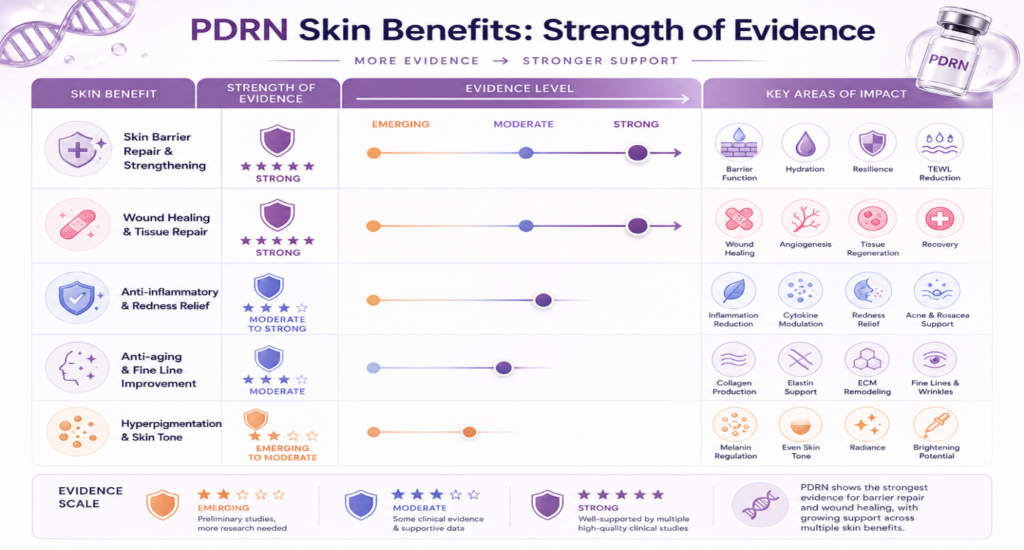
Not all PDRN benefits are backed by the same quality of evidence — wound healing has the strongest support
PDRN vs PN: What’s the Difference?
PDRN and PN are frequently used interchangeably in marketing and even in some published research, but the studies reviewed here treat them as related, not identical, compounds. Both are DNA-derived biopolymers, typically sourced from salmon or trout, and both appear to work partly through the same A2A receptor and salvage pathway mechanisms described above. The key structural difference is chain length and molecular weight: PN is generally the longer-chain, higher-molecular-weight version, while PDRN refers to shorter fragments.
That distinction affects behaviour. Longer PN chains form a thicker, gel-like structure that holds onto water, positioning PN as a structural, hydrating skin booster. Shorter PDRN chains are more fluid and generally associated with signalling-based effects, like anti-inflammatory and regenerative activity, rather than a physical volumizing one.
There’s no single, universally agreed molecular-weight cutoff separating the two terms. One recent scientific review proposes a specific threshold, referred to as the ‘Marques Polynucleotide Cutoff’, set at 1,500 kDa, suggesting fragments below this weight be called PDRN and those at or above it be called PN. This is a proposed, structure-based classification from that particular review, not an internationally accepted regulatory or scientific standard. Other papers use different weight ranges, and manufacturers often apply the terms according to their own proprietary extraction processes rather than a shared definition. In practice, a product labelled ‘PN’ from one company could share a similar molecular weight with a product labelled ‘PDRN’ from another.
| Feature | PDRN | PN |
| Polymer size | Shorter chains | Longer chains |
| Molecular weight | ~50–1,500 kDa (varies by source) | Often cited ≥1,500–2,000 kDa; some formulations described up to several thousand kDa |
| Physical properties | More fluid, lower viscosity | Thicker, gel-forming, higher viscosity |
| Main mechanisms | A2A receptor activation; nucleotide salvage pathway | Structural/hydrating support; ECM scaffolding; also engages A2A and salvage pathway to a degree |
| Common applications | Wound healing, anti-inflammatory use, regeneration, topical serums | Skin boosters, hydrating injectables, dermal volumizing support |
| Typical formulation | Liquid/solution | Hydrogel |
How Is PDRN Used in Skincare and Aesthetic Treatments?
PDRN appears in skincare in two very different forms, and it’s worth being clear about the distinction.
Topical PDRN, found in serums and creams, is applied to the skin’s surface. Because intact skin is a fairly effective barrier and larger molecules like DNA fragments don’t cross it easily, the evidence supporting meaningful benefit from topical PDRN alone is much thinner than the evidence for injectable use. Some formulations use lower-molecular-weight PDRN specifically because smaller fragments are thought to penetrate more readily, but this remains an active area of formulation research rather than a settled point.
Injectable PDRN and PN, by contrast, are administered by trained medical professionals, typically through a series of fine-needle injections into the dermis. This is where the bulk of the clinical evidence, including randomised trials, comes from. Injectable treatments are also increasingly used after energy-based procedures like laser resurfacing, microneedling or radiofrequency, based on the idea that PDRN’s wound-healing properties may support recovery. Some preclinical and small clinical studies support this use, though well-powered human trials in this exact post-procedure setting are still limited.
A topical PDRN serum and an in-clinic PDRN injection are not interchangeable in terms of evidence or expected effect, even though they share an ingredient name.
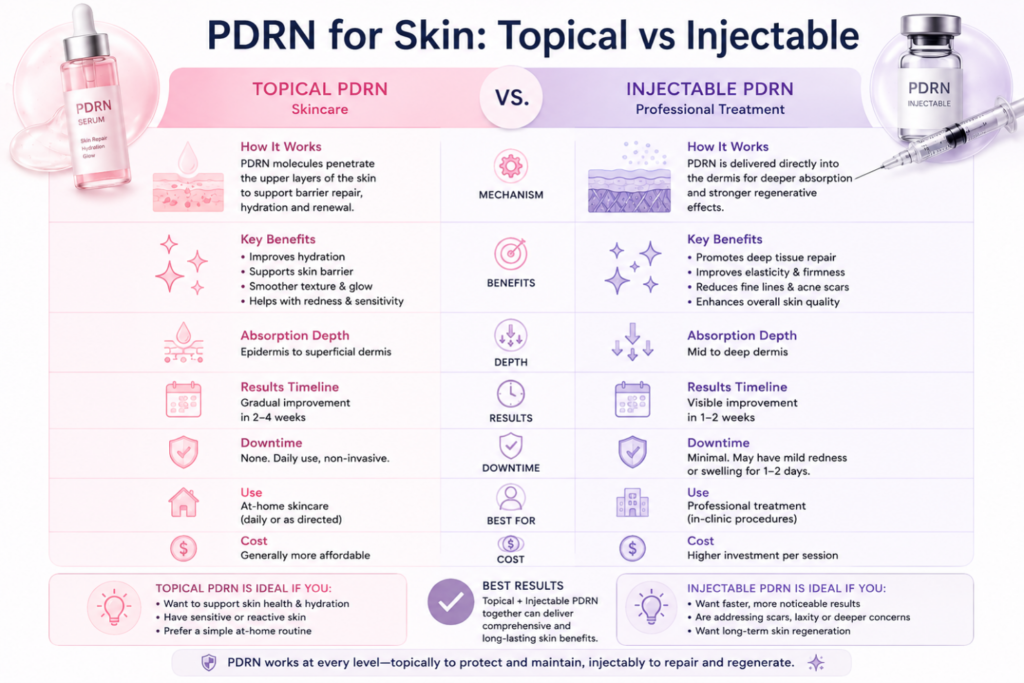
Topical and injectable PDRN differ substantially in penetration, evidence base, and required oversight.
Is PDRN Safe?
Across the studies reviewed, PDRN has generally been well tolerated. Toxicity studies in animals have not found evidence of organ damage from PDRN, and human clinical trials, including large randomised studies in diabetic foot ulcer patients, have reported no serious drug-related adverse events. Where side effects occur, they tend to be mild and temporary: redness, swelling, itching, or discomfort at the injection site.
Purification matters. Because PDRN is processed to remove proteins and peptides that could otherwise trigger an immune reaction, manufacturing quality plays a real role in tolerability, which is one reason unregulated or poorly sourced products are a greater concern than the pharmaceutical-grade formulations used in clinical studies.
PDRN’s regulatory status also differs by country: in some regions it’s classified as a prescription pharmaceutical for wound healing, while PN-based products may be classified as medical devices; in other markets, PDRN-related ingredients appear in over-the-counter cosmetics. Injectable PDRN or PN treatments should only be performed by a qualified medical professional, and anyone considering them should discuss individual suitability rather than self-administering.
Frequently Asked Questions About PDRN
What does PDRN do for skin?
Research suggests PDRN reduces inflammation, supports new blood vessel formation, and helps fibroblasts repair tissue. Most of this evidence comes from wound-healing studies, with aesthetic uses like texture and pigmentation support still an active area of ongoing research.
Does PDRN stimulate collagen?
Laboratory studies show PDRN can increase fibroblast production of collagen types I and III while reducing the collagen-degrading enzyme MMP-1. This supports a role in collagen turnover, though it isn’t the same as a guaranteed, visible increase in firmness for every user.
Is PDRN the same as PN?
No. They’re closely related DNA-derived compounds, but PN generally refers to longer, higher-molecular-weight chains, while PDRN refers to shorter ones. Terminology has historically been inconsistent across research and commercial labelling, so the same molecular weight can appear under either name.
Does PDRN help with wrinkles?
Some evidence, mostly from PN studies, points to modest improvements in wrinkle appearance and elasticity after a treatment course. PDRN is not proven to eliminate wrinkles, and results vary between studies and individuals.
Can PDRN help hyperpigmentation?
Laboratory research shows PDRN can suppress melanin-producing pathways in cells, and one small uncontrolled pilot study reported improvement in patients with facial pigmentation. This is an early, limited evidence base rather than confirmed clinical proof.
Is PDRN safe?
Available studies generally report favourable tolerability, with mild, temporary side effects like injection-site redness being the most common issue. No serious safety concerns emerged in the clinical trials reviewed, though injectable treatments should always involve a qualified professional.
Is PDRN better than hyaluronic acid?
They work differently rather than one simply being ‘better’. In one split-face trial, PN produced short-term results comparable to hyaluronic acid filler, with some evidence of longer-lasting elasticity and hydration benefits. Larger, direct comparisons remain limited.
How is PDRN used in skincare?
It appears in topical serums, where penetration and evidence are more limited, and in professional injectable treatments, where most of the clinical research and regulatory oversight exists. The two forms are not interchangeable in terms of expected effect.
The Bottom Line
PDRN for skin is a DNA-derived compound with a genuinely substantial research base, most of it built on decades of wound-healing science rather than aesthetic marketing. Its two proposed mechanisms, A2A receptor activation and the nucleotide salvage pathway, offer a plausible, well-documented explanation for its anti-inflammatory and regenerative effects. The evidence for wound repair is comparatively strong; the evidence for cosmetic benefits like wrinkle reduction, hydration and pigmentation is promising but earlier-stage, and PN and PDRN are often confused despite meaningful structural differences. As with most emerging aesthetic ingredients, it’s worth treating dramatic before-and-after claims with some scepticism and discussing injectable options with a qualified professional rather than assuming lab findings translate directly into guaranteed results.